A THCa patch is one of the simplest ways to build a recovery cannabis routine that stays in the background while you keep living your life. You put it on, you go about your day, and the goal is steady body support without the mental “lift” many people associate with THC.
If you’re curious but cautious, you’re in the right place. Below, you’ll get a clear, real-world explanation of THCa, why a transdermal patch feels different from a topical, and how to use Mary’s Medicinals patches in a way that actually fits a normal schedule.
THCa patch and recovery cannabis: what “recovery” really means here
When you see “recovery” on a cannabis product, it’s usually speaking to a very specific moment. Think: the day after leg day, a long shift on your feet, travel stiffness, or that low-grade tightness you notice once you finally sit down. You are not looking to check out. You are looking to stay comfortable enough to keep moving.
That’s why recovery cannabis formulas often lean on non-intoxicating cannabinoids and delivery methods built around consistency. In other words, you aim for support that feels even, not intense.
What is THCa, and why people pick it for recovery
THCa (tetrahydrocannabinolic acid) is the “raw” form of THC found in the live cannabis plant. On its own, THCa is widely described as non-psychoactive, meaning it is not typically associated with a high. For a lot of people, that is the whole point. You can keep your head clear while still giving your body something to work with.
THCa can convert into psychoactive THC through decarboxylation, which is what happens with heat and certain processing. If you want a straightforward explainer on how patches and gels are designed for transdermal delivery, nurse-led education group Leaf411 breaks it down in their overview of transdermal cannabis patches and gels.
One quick expectation check: THCa is popular in wellness circles, but research is still developing, especially around specific real-world outcomes. You can still use it thoughtfully. You just want to keep your goals grounded in support, not miracle-level promises.
THCa patch vs. topical: why the delivery method changes the experience
It helps to separate two products that people lump together: topicals and transdermals.
- Topicals (like lotions or Mary’s compounds) are generally used for localized, spot-specific comfort.
- A THCa patch is a transdermal cannabis product, designed to move cannabinoids through the skin and into the bloodstream for more system-wide support.
If you have ever used a topical and thought, “This feels nice, but I wish it lasted longer or reached a little deeper,” that is often what leads people to try transdermal delivery. March and Ash also explains this difference between patches and topicals in their guide on how cannabis patches work.
If you want Mary’s own quick comparison of formats, you can browse Mary’s Medicinals Transdermal & Topical Products and see what each option is designed to do.
Why transdermal cannabis delivery works so well for recovery routines
Recovery routines do best when they are easy to repeat. Transdermal cannabis fits that mindset because it is built for slow, sustained delivery instead of quick peaks and dips.
Here’s what people tend to like about patches for recovery days:
- Consistency: you are not chasing a fast onset or trying to time a “perfect” moment.
- Discreet use: it sits under clothing and does not add a big step to your routine.
- Accurate, repeatable dosing: especially helpful if you like to track what works for you.
- Bioavailability: transdermal products are designed so more of what you use enters circulation, which is one reason many people find they can use a lower dose compared to some other formats.
If you’re curious about where the science is headed, researchers are actively studying cannabinoid patch design and matrix systems. You can read an example of this formulation-focused work in the abstract for a ScienceDirect paper on improved transdermal delivery of novel cannabinoid-loaded patches.
Recovery (THCa) Transdermal Patch: what it’s built to support
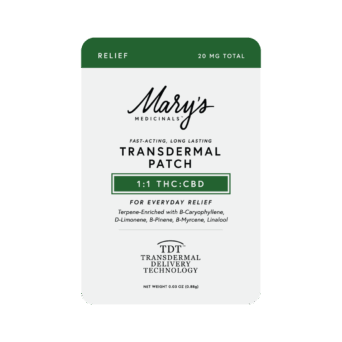
Mary’s Medicinals has been focused on transdermal delivery from the start, and the Recovery (THCa) Transdermal Patch is made for exactly the kind of day when your body wants extra support but your brain needs to stay online.
Practically speaking, it is designed to go 7 to 10 layers deep through the skin and into the bloodstream. That is a big reason customers reach for it over a standard topical when they want steady, all-day comfort rather than a quick, localized boost.
You can see the intended wear time and placement guidance on the Recovery (THCa) Transdermal Patch product page. If you like routines you can repeat, patches are nice because they are predictable. You can pair one with hydration, a walk, some mobility work, and call it a solid recovery day.
How to use a THCa patch for recovery without overthinking it
A patch is not like inhalation, where you notice a fast shift. You are playing the long game here. Think steady support, not instant feedback.
- Choose a venous area such as the inner wrist, inner forearm, top of the foot, or ankle.
- Start with clean, dry skin. Skip oils or lotion right before applying so the patch can adhere properly.
- Place it where it will not get rubbed constantly, like under a tight sock band or a waistband.
- Give it time. Check in with yourself over the full wear window, not just the first hour.
- Keep notes if you’re dialing it in. A quick “workout day vs. rest day” note can help you find your personal sweet spot.
If you are deciding between effect lines, Mary’s has a simple guide that can help you match the patch to your goals without getting lost in the weeds. It’s worth bookmarking Which Mary’s Patch Should I Choose? Your “Find Your Effect” Guide.
THCa patch considerations: product quality, evolving research, and drug testing
Two honest notes before you commit.
- Not all patches are truly transdermal. Formulation matters. A product can look like a patch and still behave like a surface-level topical if it is not built to cross the skin barrier effectively.
- Drug testing is complicated. Even if THCa is considered non-intoxicating, many tests look for THC metabolites. Cannabis chemistry is nuanced, and your personal risk depends on your job, your athletic organization, and the type of test.
If you are subject to drug testing, it is smart to review your policy and talk with a qualified healthcare professional before using any cannabinoid product.
FAQ: THCa patch basics for recovery cannabis routines
Does a THCa patch get you high?
THCa is commonly described as non-psychoactive, so it is not typically associated with a high. That said, everyone’s sensitivity is different and product design matters. If you want to stay clear-headed, start low and pay attention to your personal response.
How is a THCa patch different from a compound?
Mary’s compounds are topical and meant for spot-specific comfort, often lasting around 3 to 5 hours. A THCa patch is transdermal and designed for deeper delivery through the skin and into the bloodstream for more systemic support.
How long does a THCa patch last?
It depends on the specific product and how you use it. The Recovery (THCa) Transdermal Patch is designed for extended wear so you can keep support steady through a long day.
Where should you place a THCa patch?
Most people do best with venous areas like the inner wrist, inner forearm, ankle, or top of the foot. Aim for clean, dry skin and avoid high-friction spots.
Can you use a THCa patch after a workout?
Yes. Many customers use a patch after training because it is discreet and built for sustained delivery. Just remember that recovery works best as a stack: hydration, protein, sleep, and mobility still do a lot of the heavy lifting.
Conclusion: THCa recovery is about steady support you can live with
When you choose a THCa patch, you are choosing a recovery cannabis approach that prioritizes consistency, discretion, and a clear head. Transdermal cannabis delivery is not about chasing a big moment. It’s about giving your body steady support so you can keep showing up for your workouts, your work, and the rest of your life.
If you want a practical starting point, take a look at the Recovery (THCa) Transdermal Patch, then build your routine around what you already know helps you recover. If you ever get stuck between formats or effect lines, Mary’s educational resources can help you choose with confidence.